This report evaluates the raw signal quality of the ring’s two sensing modalities — the tri-axial accelerometer (ACC) and the dual-channel optical PPG — from on-device BLE exports. The question is narrow and concrete: are the raw signals clean, complete, and physiologically faithful enough to build algorithms on? We answer it by characterising the raw waveforms directly and by running deliberately simple reference algorithms (step counting, HR, HRV) whose outputs can be checked against an independent ground truth.
Supporting detail lives in companion analyses: accelerometer EDA, overnight PPG, data-quality & channel insights, and the step/HR verification walkthroughs.
1. Scope & method
In scope: completeness (sampling, gaps), fidelity (does the waveform carry the physiology), and the two PPG channels’ relative quality.
Method:
- Direct characterisation of the raw ACC and PPG waveforms (rates, units, spectra, morphology, perfusion).
- Verification by simple reference algorithms — a DSP step counter on ACC, and spectral-HR + beat-to-beat HRV on PPG — chosen to be transparent so that any error is attributable to the signal, not to a black-box model.
Reference signals available: Apple Watch step counts (for ACC) and the ring’s own firmware HR output (for PPG). The PPG checks are therefore internal consistency (our estimate vs the device’s estimate on the same raw signal) plus physiological plausibility — not a comparison against a gold-standard pulse oximeter or PSG, which is a separate clinical-validation exercise.
2. Data inventory & integrity
Three capture sets were used:
| Set | Content | Use |
|---|---|---|
| Step | 62 labelled recordings, ~14.7 h (walk/jog/stairs + typing/brushing/eating) | ACC fidelity vs Apple-Watch steps |
| Sit | ~25 min seated clip | PPG HR/HRV verification |
| Sleep | 8 overnights + 1 nap (~58 h) | PPG behaviour over long sessions, dual-channel |
Completeness. The ACC step stream is pristine — a perfectly regular 25 Hz grid (every row holds exactly 25 samples; no dropped or zeroed accelerometer rows). The longer PPG captures are duty-cycled (~30 % on during sleep, ~95 s ON windows every few minutes) and the BLE link drops some wall-clock time:
| Night | Missing time | Night | Missing time | |
|---|---|---|---|---|
| sleep1 | 7.8 % | sleep6 | 8.3 % | |
| sleep5 | 7.2 % | sleep7 | 6.8 % | |
| sleep8 | 7.7 % | sleep4 | 31.8 % |
Most nights lose 7–8 % to gaps (largest ~2.5 min); one night (sleep4) lost a
third and should be down-weighted in any downstream use. Caveat for tooling:
the rawSeq counter increments per delivered row even across a gap, so it cannot
detect loss — gaps must be found from TIMESTAMP. Wear detection (wristOff) was
effectively always-on, i.e. good contact throughout.
3. Accelerometer signal quality
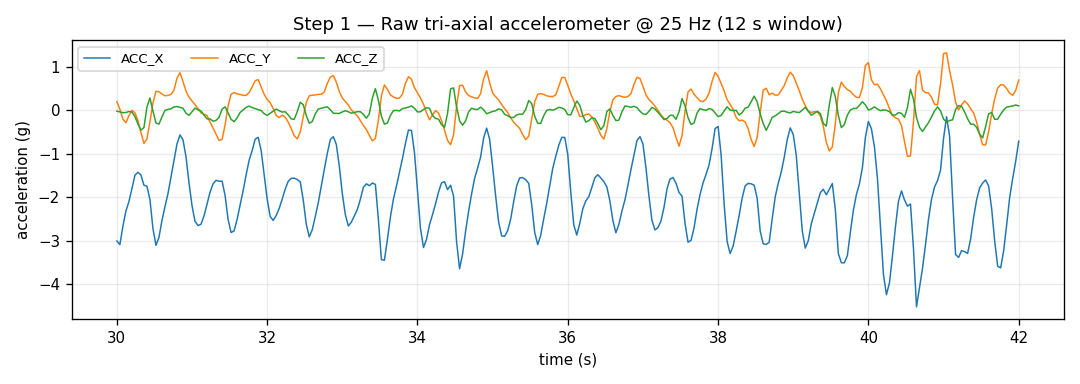
Raw stream. The three axes are clean 25 Hz oscillations in milli-g. Because the ring rotates freely on the finger, no single axis is a stable reference — the per-axis gravity component averages 0.35–0.88 g (not 1.0), confirming continuous orientation drift.
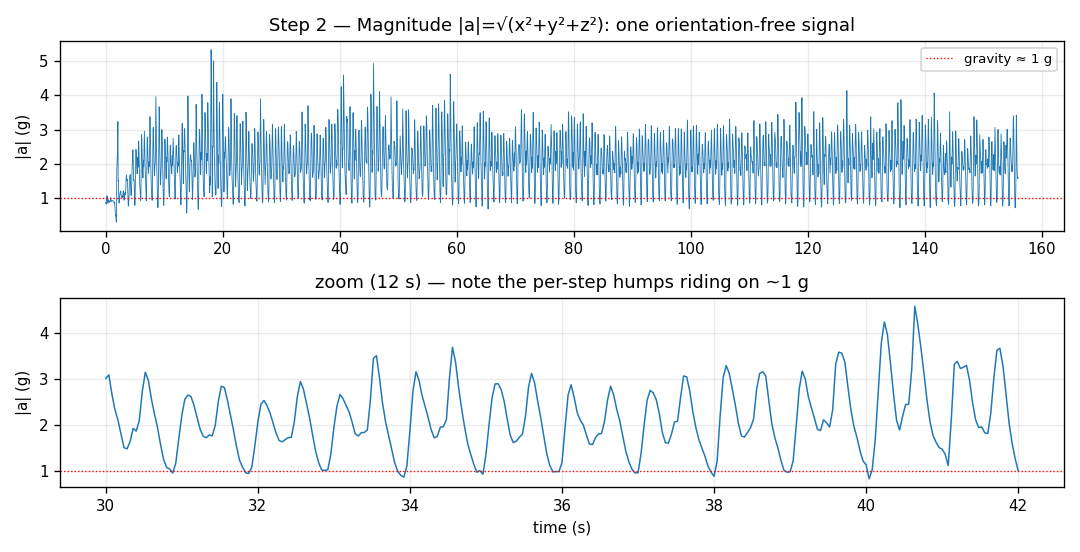
Orientation-invariant magnitude. Collapsing to |a| = √(x²+y²+z²) removes the
orientation dependence; each footfall becomes a clear hump on the ~1 g baseline.
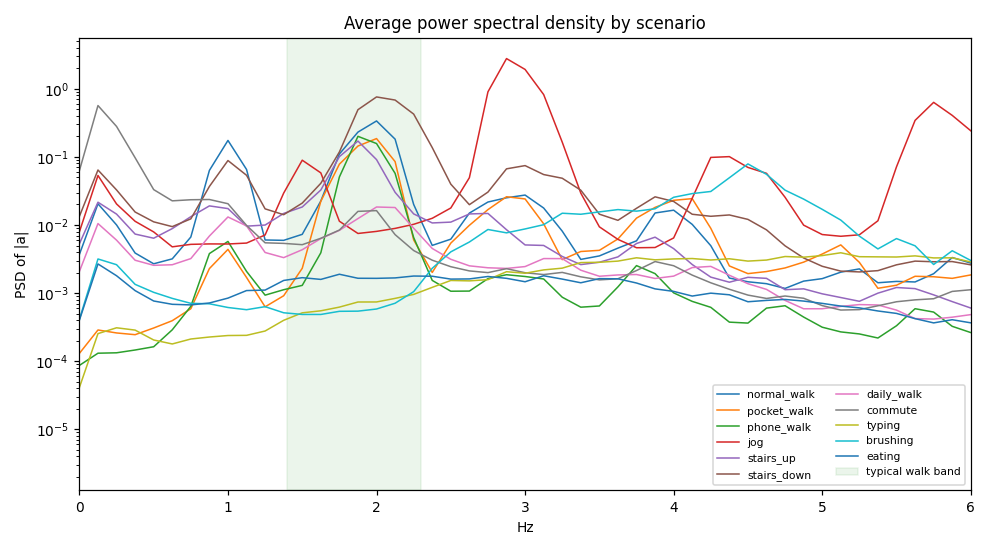
Spectral fidelity — the key result. The fundamental frequency of |a| tracks
the true step cadence almost 1:1 (≈1.8–2.0 Hz walking, ≈3.0 Hz jogging), and the
locomotion band is cleanly separated from non-gait activity. This is the single
most exploitable property of the accelerometer signal.
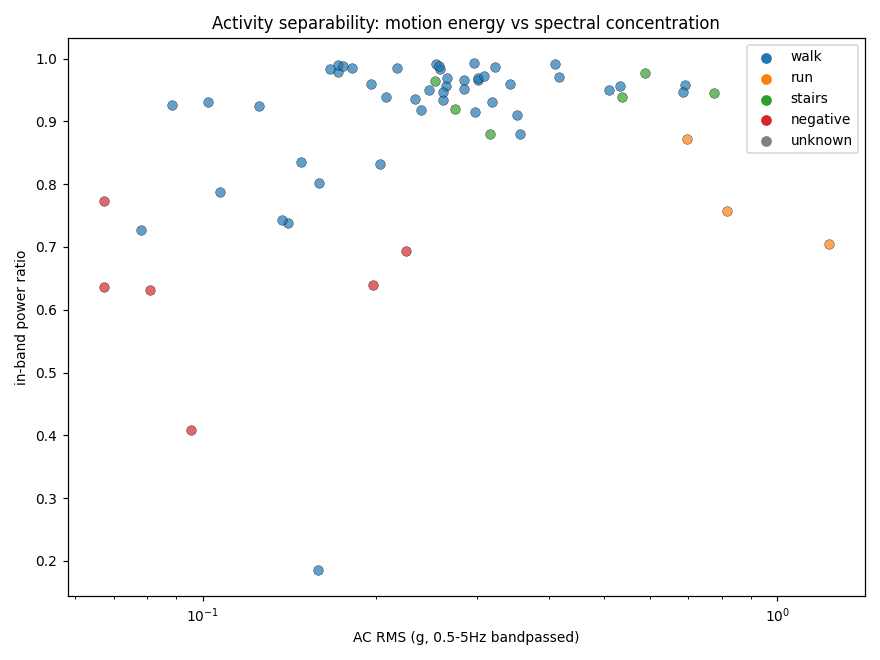
Verification (steps vs Apple Watch). A transparent DSP step counter (magnitude → 0.7–5 Hz band-pass → activity gate → adaptive peak detection) lands at 4.1 % macro-average absolute step error across scenarios (e.g. phone-in-hand walk 1.0 %, jog 2.6 %, commute 5.0 %). Negative activities (typing, eating) are fully rejected; only tooth-brushing (~3 Hz, ~1-axis) overlaps the gait band — an inherent accelerometer-only ambiguity, not a signal-quality defect. (Detailed in the companion step-counting walkthrough.)
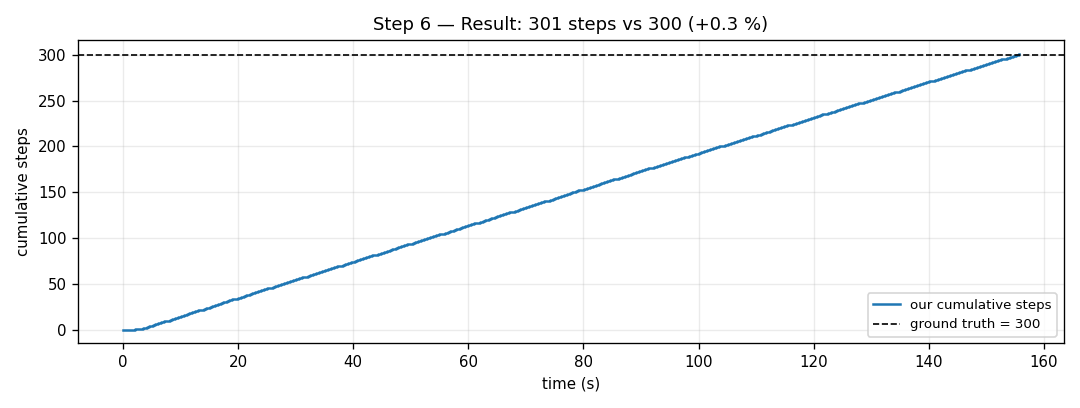
Verdict — ACC: complete (no loss), well-scaled (milli-g, gravity ≈ 1000), and spectrally faithful to gait. The signal is algorithm-ready; use the orientation-invariant magnitude, not raw axes.
4. PPG signal quality
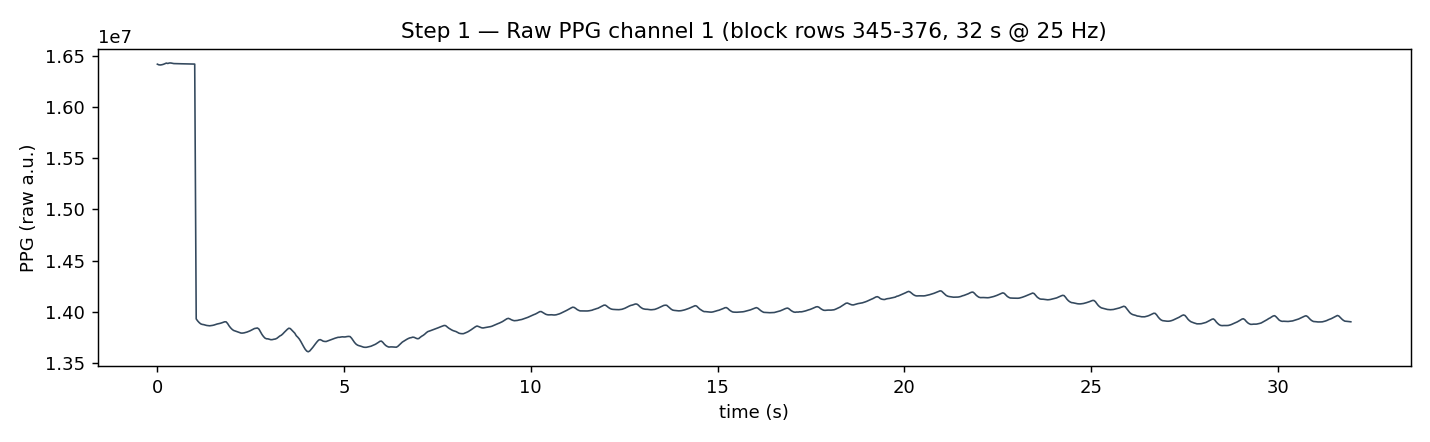
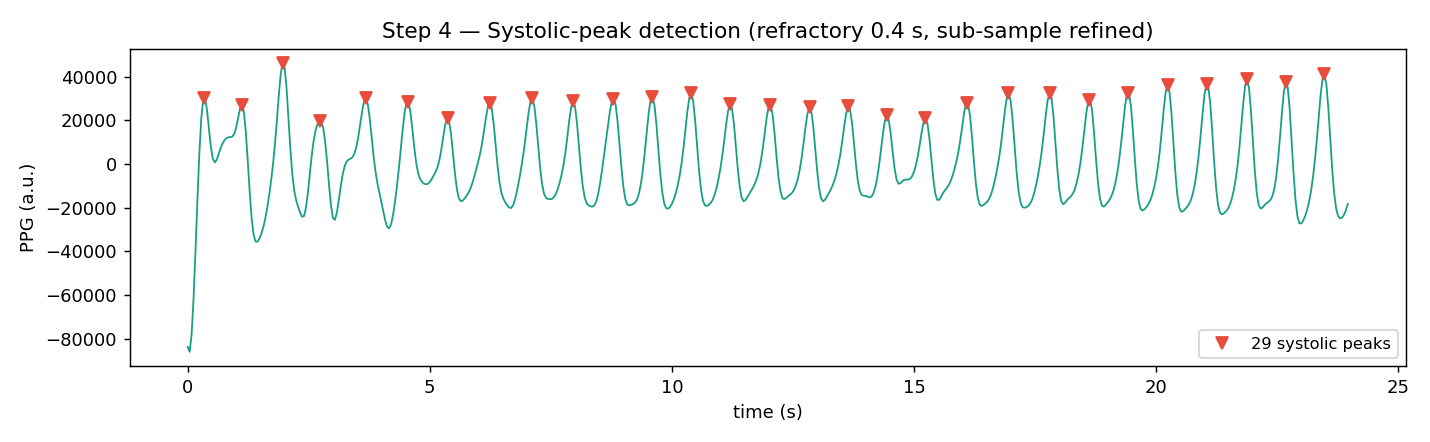
Raw pulse. After removing the DC/perfusion baseline (band-pass 0.7–3.5 Hz) the PPG shows a clean, regular pulse with a clearly resolved dicrotic notch — evidence of good morphological fidelity, not just a blob at the heart rate.
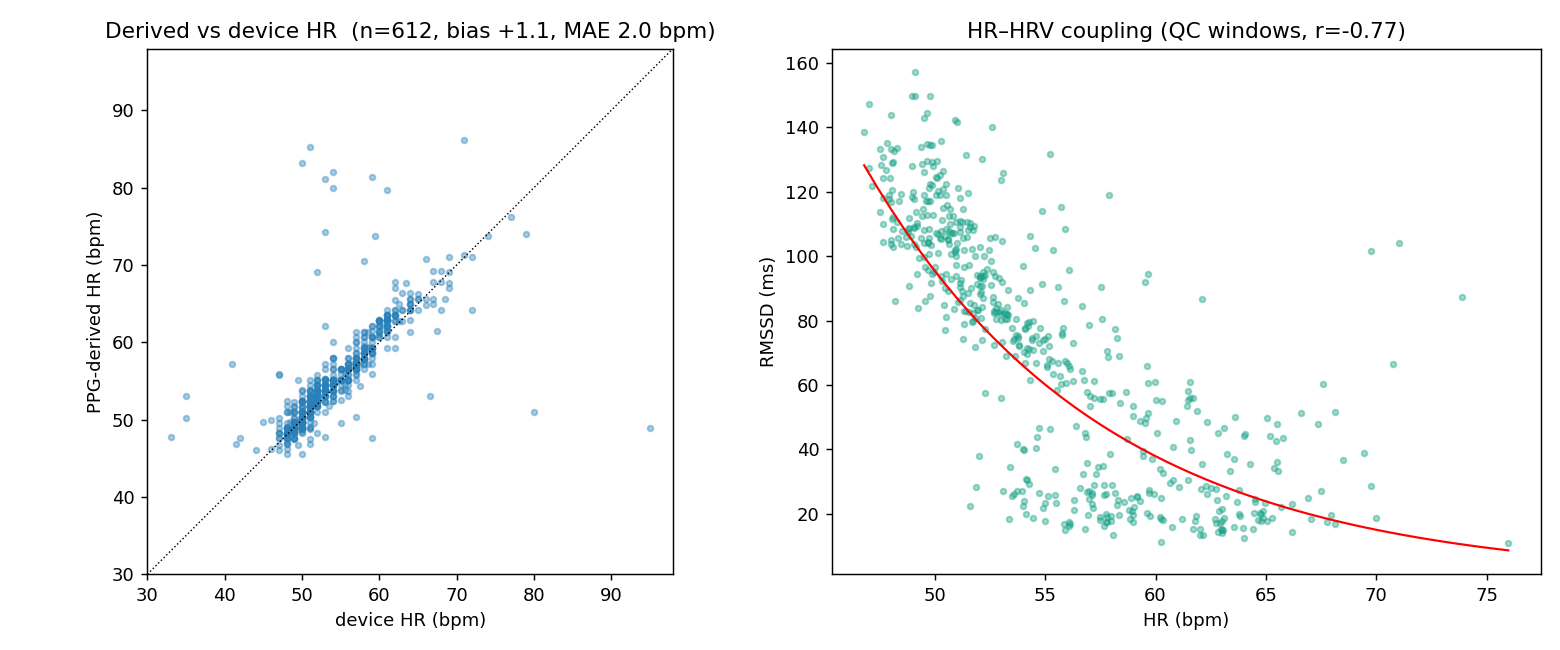
HR fidelity (vs the device’s own HR). A spectral-peak HR estimate from the raw PPG matches the firmware HR with bias +1.1 bpm, MAE 2.0 bpm over 600+ matched windows, and the HR–HRV relationship is the textbook inverse coupling (r = −0.77) — i.e. the raw signal carries genuine autonomic structure, not artefact. (This is internal consistency on the same raw signal; absolute accuracy vs an oximeter is out of scope here.)
HRV fidelity. Beat-to-beat intervals from the raw PPG yield physiologically sensible time-domain HRV (resting RMSSD ≈ 40 ms, SD1/SD2 structure intact), recovered with sub-sample peak refinement to offset the coarse 25 Hz clock. (Detailed in the companion HR/HRV walkthrough.)
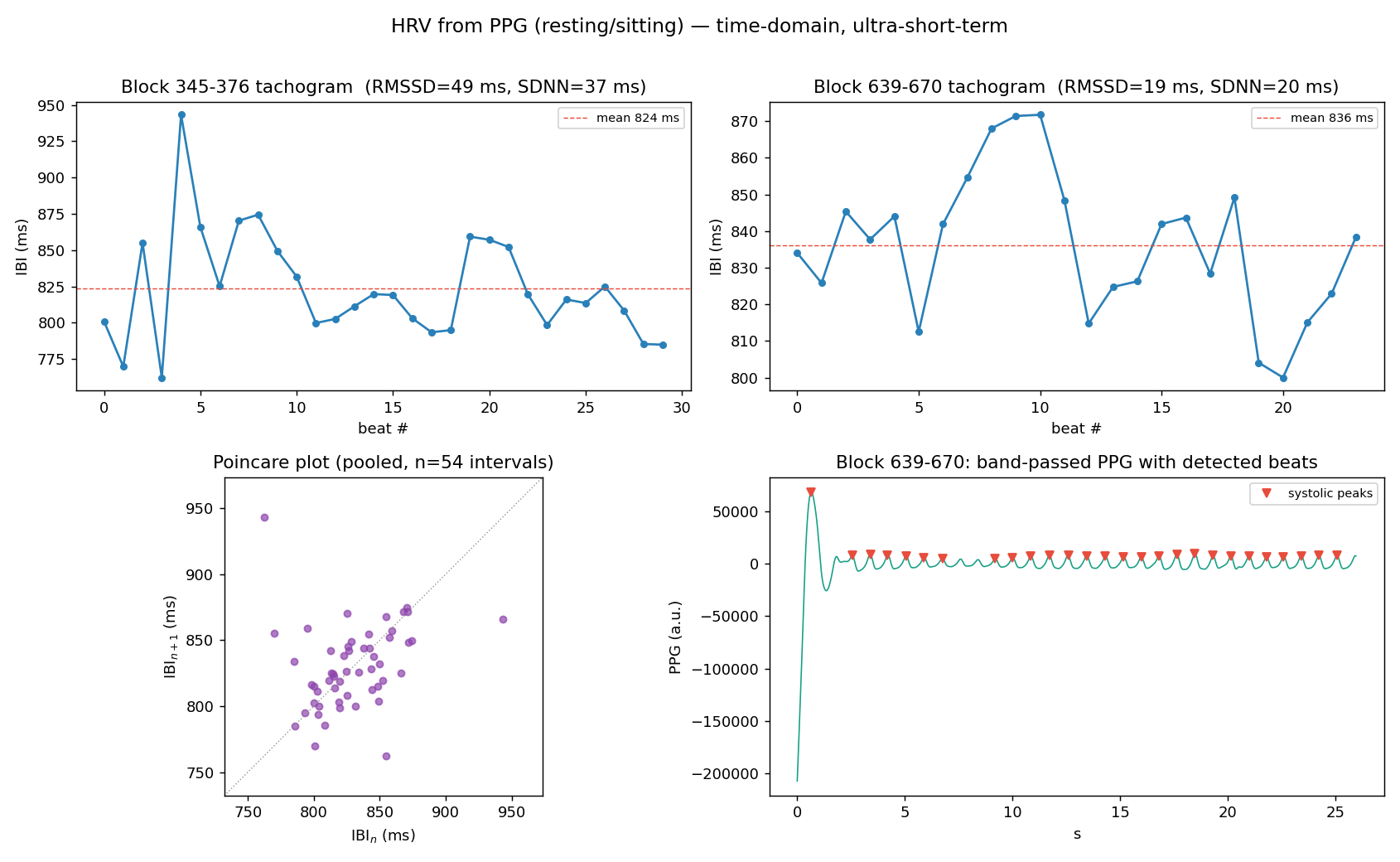
Known signal-quality dependency. Wrist/finger PPG HRV magnitude depends on perfusion strength and pulse morphology — weak-perfusion windows under-represent variability, and prominent dicrotic notches can mislead naïve beat detection. This is the main thing to gate on downstream (see §5 for the free quality signal the second channel provides). HR (spectral) is robust to it; absolute HRV is not.
Verdict — PPG: the raw pulse is morphologically faithful and supports robust HR and plausible HRV; the live constraints are the ~30 % duty cycle (sparse sampling, not low quality) and perfusion-dependent HRV amplitude.
5. Dual-channel PPG (PD1 vs PD2)
The GH3026’s two photodiodes give two simultaneous pulse channels — a redundancy worth quantifying (446 analysed windows).
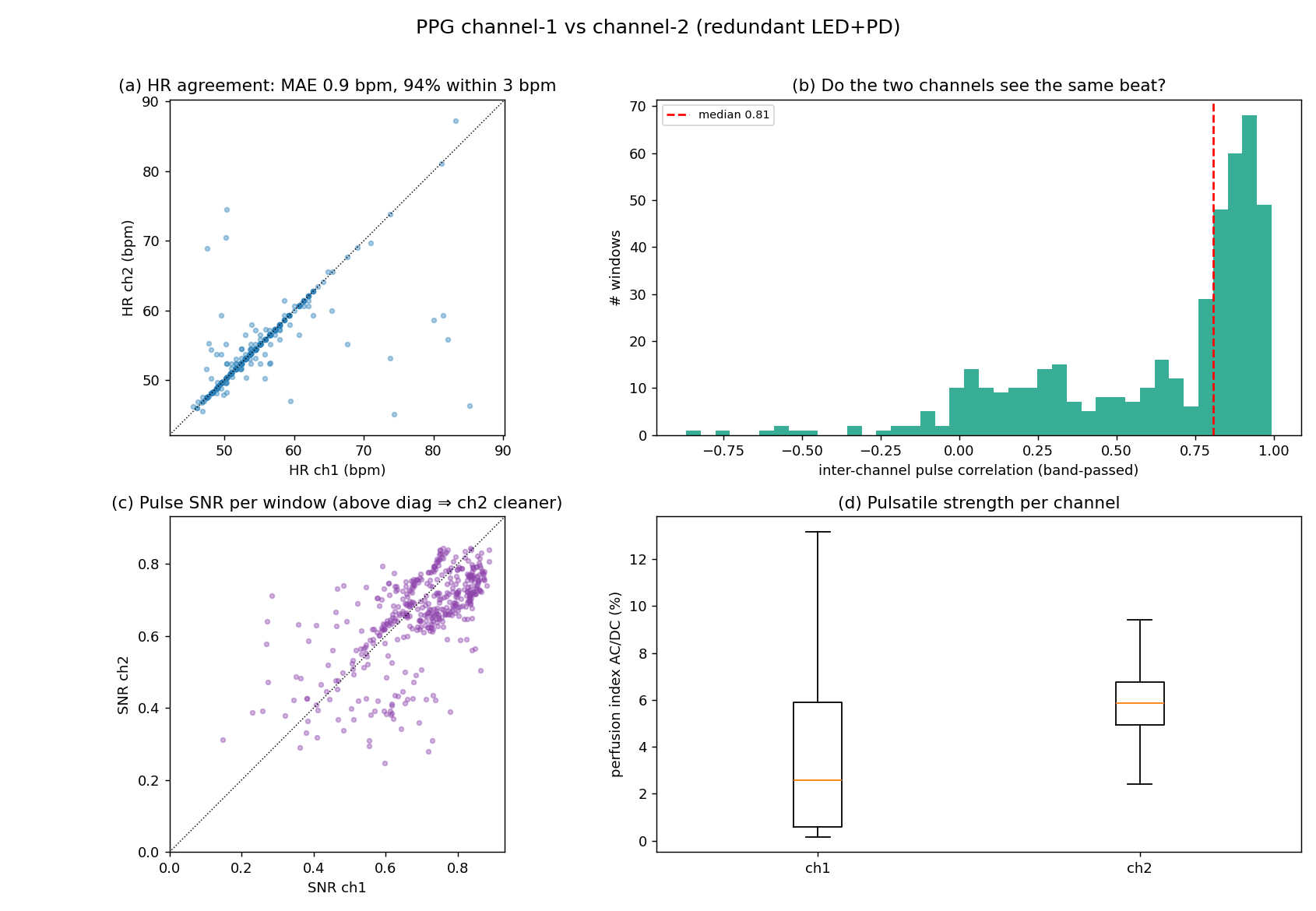
- They agree on HR: bias +0.2 bpm, MAE 0.9 bpm, 94 % of windows within 3 bpm — two independent, consistent HR estimates.
- They see the same beat: band-passed inter-channel pulse correlation median 0.81 (>0.5 in 70 % of windows) — so the inter-channel correlation is a free, built-in signal-quality / motion-artefact flag that a single channel cannot provide.
- They are complementary: ch1 is marginally cleaner spectrally (SNR 0.73 vs 0.69), while ch2 has a markedly stronger pulse (perfusion index AC/DC 5.9 % vs 2.6 %).
One- vs two-channel value (yield of usable windows, vs the better single channel ch1):
| Quality bar | ch1 alone | dual best-of-2 | gain |
|---|---|---|---|
| lenient (SNR ≥ 0.4) | 96.0 % | 98.4 % | +2.5 pp |
| normal (SNR ≥ 0.5) | 91.5 % | 94.4 % | +2.9 pp |
| strict (SNR ≥ 0.6) | 80.0 % | 87.0 % | +7.0 pp |
| very strict (SNR ≥ 0.7) | 56.1 % | 65.2 % | +9.2 pp |
For HR the second channel adds essentially nothing (MAE 2.00 → 1.97 bpm); for clean-beat-dependent features (HRV) it rescues ~3 % of windows at a normal bar, rising to ~7–9 % when pristine beats are required — and supplies the artefact-flag above. These numbers come from low-motion sleep (the easy case), so they are a lower bound on the redundancy’s value under daytime motion. (Detailed in the companion channel-insights analysis.)
Verdict — dual channel: the two PDs validate each other on HR and are complementary on SNR vs perfusion; their cross-correlation is a cheap, real quality gate.
Appendix — at a glance
| Modality | Completeness | Fidelity | Verified by |
|---|---|---|---|
| Accelerometer | no loss, regular 25 Hz | cadence tracked 1:1; orientation-invariant on |a| | 4.1 % step MAE vs Apple Watch |
| PPG (per channel) | ~30 % duty cycle; 7–8 % BLE gaps | clean pulse w/ dicrotic notch; robust HR, perfusion-dependent HRV | HR MAE 2.0 bpm vs device; HR–HRV r = −0.77 |
| PPG dual-channel | two simultaneous PDs | agree on HR; complementary SNR/perfusion | inter-channel MAE 0.9 bpm, corr 0.81 |
Part 2 will move from signal quality to the algorithms built on these signals.