Lauren Tan’s talk on building agent teams made me reconsider what changes when intelligence becomes abundant and affordable. Cloud computing once allowed a single person to move from operating one computer to coordinating thousands. Something similar is beginning to happen with intellectual work. Building a professional team has traditionally required capital, organizational resources, and layers of management. Agents make it increasingly possible for an individual to assemble execution capacity of their own. But as that capacity grows, human attention becomes the constraint. If every task still requires a person to assign it, supervise it, and inspect the result, adding agents quickly reaches a ceiling. The opportunity is to develop the ability to organize intelligence: defining work, distributing responsibility, and creating conditions in which progress can continue without constant intervention.
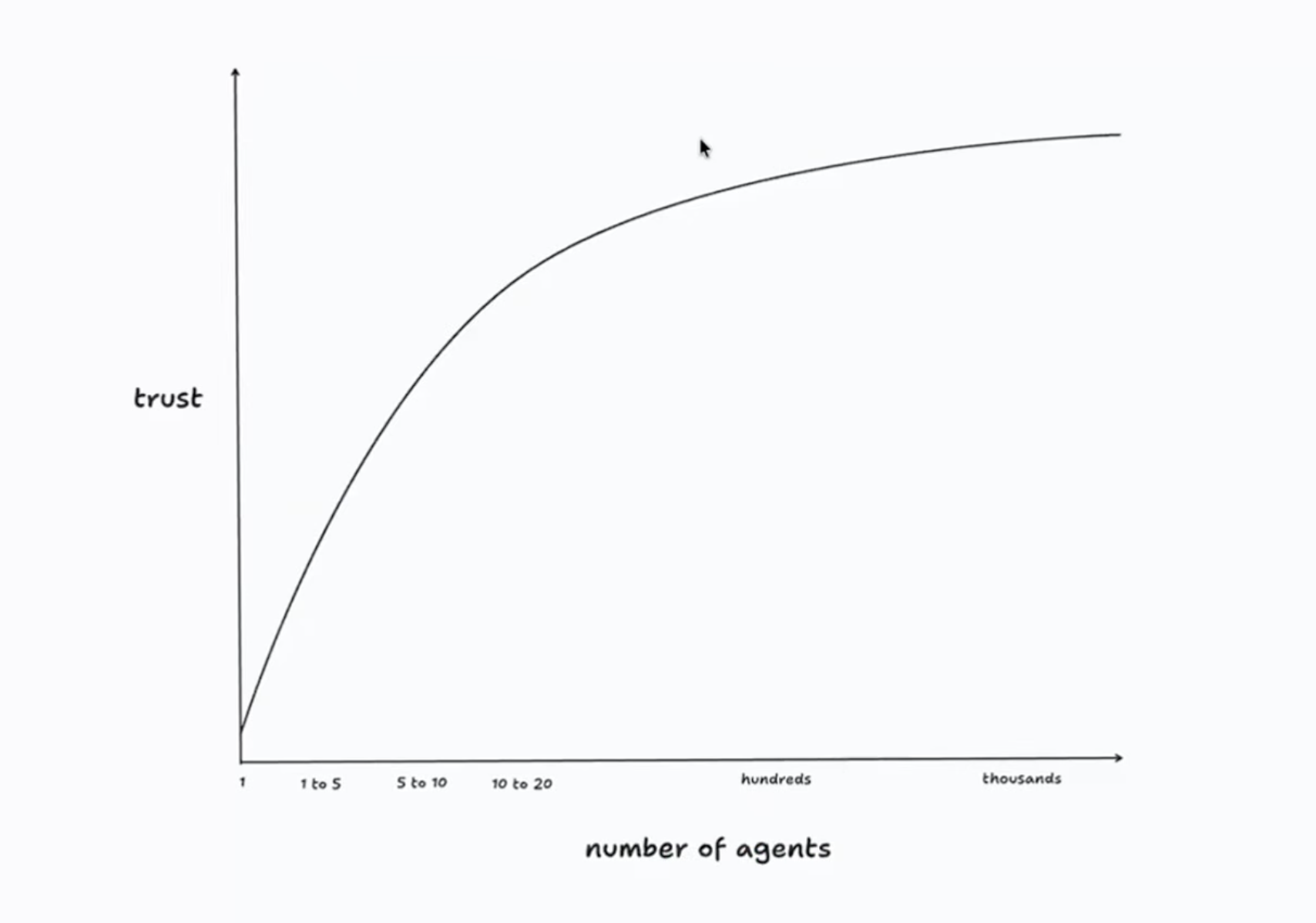
A chart from Tan’s talk connects trust with the number of agents a person can work with. I read it as a condition for scaling: before you can reliably delegate to one agent, adding more will mostly increase your coordination and review burden. Building that trust resembles developing trust with employees. Onboarding provides context and tools; clear responsibilities establish boundaries; shared standards define acceptable results; feedback makes correction possible. Through repeated collaboration, you learn which tasks you can delegate, which outputs need verification, and which decisions remain yours. Trust has a scope, and that scope expands through reliable delivery. Verification is central to this process. Without an appropriate verifier, you become the verifier. Tests, evaluations, and feedback loops provide grounds for delegation, allowing additional agents to expand useful capacity.
Organizing agents is therefore an exercise in system design. A good system gives members with different capabilities appropriate responsibilities, allows routine work to proceed independently, makes failures visible, and directs consequential decisions to the right person. The same principles support effective human organizations: clear goals, sufficient context, thoughtful delegation, and dependable feedback make larger-scale collaboration possible. The person’s role gradually shifts toward deciding what matters, shaping the working environment, establishing standards, and exercising judgment where it is needed. For someone with substantial professional experience, this offers a practical direction: translate that experience into task boundaries, evaluation criteria, and feedback mechanisms that a team can use repeatedly. AI’s value then extends beyond individual productivity to the scale of effort a person can organize—and the kinds of work they can independently initiate and sustain.