The Phenomenon
The chart below is one night of data from an Oura ring, plotted against concurrently recorded polysomnography. The top panel is the accelerometer. The bottom panel is temperature, colored by sleep stage.
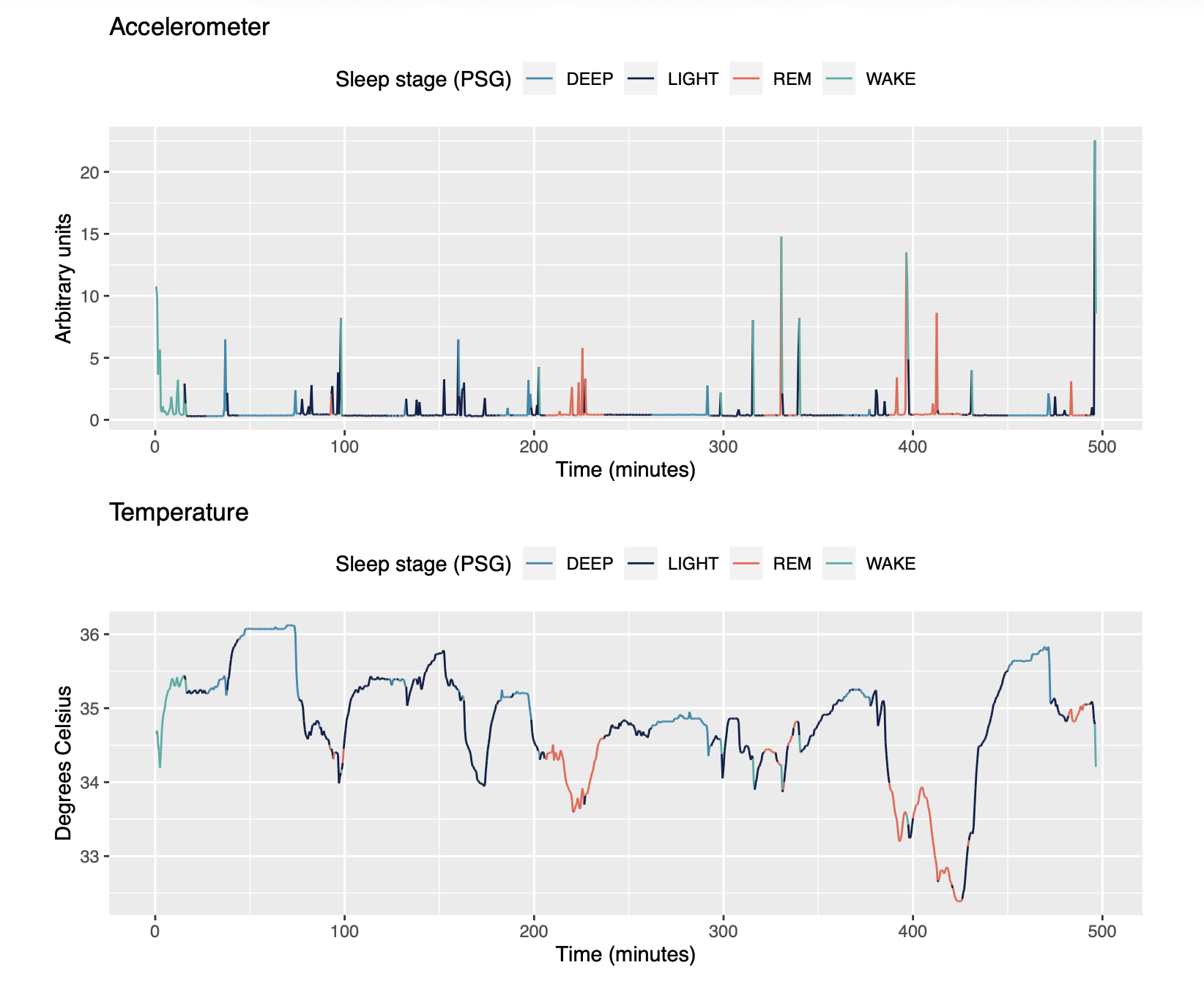 Temperature and accelerometer channels from one night of Oura ring data, staged against concurrent PSG. Source: Altini & Kinnunen, “The Promise of Sleep,” Sensors 21(13):4302, 2021.
Read the range first: the trace bottoms out near 32.5 °C and peaks just over 36 °C — a swing of about 3.6 °C between lights-out and morning.
Now hold that against what the body is actually doing. Core temperature in a healthy adult follows a circadian curve with a nighttime nadir roughly half a degree below the daytime plateau. The entire physiological excursion across a night is well under 1 °C. So of the 3.6 °C the ring recorded, something like a quarter is physiology. The rest is the measurement.
The trace also moves with the sleep stages rather than smoothly across them. The deepest excursions land in REM and in wake. That is a clue about mechanism, and it is not a clue about core temperature.
That gap — between what the body did and what the ring recorded — is the subject of this article. The question is not how to build a better thermometer. It is why a temperature reading on a wearable is never as stable as the thing it claims to measure.
The Causes
A thermistor costs cents and resolves better than ±0.1 °C. Precision is not the scarce resource here. Four other things are:
- Contact. Skin temperature requires the sensor to actually sit against skin. An air gap — even a fraction of a millimeter — decouples the reading from the body and lets it drift toward ambient.
- Position. Palmar versus dorsal. Proximal phalanx versus distal. Different blood supply, different exposure, different distance from the feeding artery. Move the sensor a few millimeters and the reading shifts.
- Perfusion. Skin temperature at the finger is largely a vasomotor signal. The arteriovenous anastomoses in the fingertip constrict and dilate to dump or conserve heat, and they do it in seconds. A fingertip can swing several degrees with no change in core temperature at all. During REM, thermoregulation is largely suspended — which is exactly why the largest excursions in the trace above sit where they do.
- Ambient. A hand outside the blanket and a hand under it are in different thermal environments, and the trace above does not record which one it was.
None of these are sensor problems, but all of them show up as sensor readings. Contact is also where comfort and accuracy fuse: a ring sized for the daytime finger goes tight at night, a ring sized for the swollen finger gaps by day, and that gap is an accuracy problem before it is ever a comfort problem. As argued in Comfort Is the Next Frontier, fit, comfort, and data quality are the same problem wearing three hats.
The Options
Temperature can be measured at three distances from the core. Each distance is a different product category, with its own accuracy claim and its own ceiling.
Core temperature is the real thermal state of the body — pulmonary artery, esophagus, or the gastrointestinal tract. It is the reference everything else is validated against, and it is invasive. BodyCap (Caen, France) sells the eCelsius capsule for it: 1.7 g, 17.7 mm, single-use, swallowed, transmitting at 30-second intervals to ±0.1 °C until the body expels it 24 to 48 hours later. It is FDA-cleared as a medical device and cited in more than 150 publications. CORE, from the Zurich ETH spin-off greenTEG, goes the non-invasive route: a thermal-flux sensor worn on the chest, mean absolute error of 0.21 °C, validated against ingestible pills and sold to athletes and researchers rather than clinicians.
Basal body temperature is oral, vaginal, or rectal, taken at rest after sleep. It is a clinical proxy defined as much by its protocol as by its site, and its value is that it is standardized — same place, same conditions, every time. OvuSense built a fertility product on a vaginal sensor and a fifteen-year algorithm, validated across more than 260,000 cycles and 13 peer-reviewed publications, and FDA-cleared for intravaginal use. In August 2025 Ultrahuman acquired viO HealthTech, and that algorithm now ships as a $3.99/month plug-in on the Ring AIR. Note what did not travel with it: the clearance. The ring version is positioned for general wellness, not as a cleared device.
Skin temperature is what a ring or a band actually measures: continuous, comfortable, and located at a site doing active heat exchange with the environment. It is the only one of the three that can be worn around the clock without a protocol, which is precisely why it is the least precise. It is also the honest reason smart rings report trends rather than absolute core temperature — a trend survives an unknown constant offset, and an absolute number does not.
Reference
- Altini, M., & Kinnunen, H. (2021). The Promise of Sleep: A Multi-Sensor Approach for Accurate Sleep Stage Detection Using the Oura Ring. Sensors, 21(13), 4302. doi.org/10.3390/s21134302
- BodyCap Medical. eCelsius Medical — continuous core temperature monitoring. bodycap-medical.com
- CORE / greenTEG. Calera research-grade core temp sensor. corebodytemp.com